How Long Does Japan SEO Take? A Realistic Timeline for Global Companies
Last reviewed: September 2026
If you are entering Japan, the practical answer is not “SEO takes three to six months.” Japan SEO can show technical and visibility signals within weeks, but qualified organic traffic, inquiries, pipeline, and revenue usually need several months to evaluate. For a new or competitive Japan program, plan around a 6–12 month horizon. Treat that as an operating and measurement horizon—not as a promise that a target keyword will reach the Top 10 by a particular date.
The timing depends on where you start, what is already live, how competitive the Japanese SERP is, and how quickly approved work is implemented. The clock starts when changes are live, crawlable, indexable, and measurable—not when an agency sends an audit, a contract is signed, or an article is waiting for approval.
Google does not publish a Japan-specific ranking timetable. Its current guidance says that some changes take a few hours while others take several months; it recommends waiting a few weeks before evaluating a change, and notes that crawling or indexing can take days to weeks and is not guaranteed. Google’s SEO Starter Guide, core-update guidance, and recrawl guidance are the right baseline for setting expectations.
What does “a result” mean in Japan SEO?
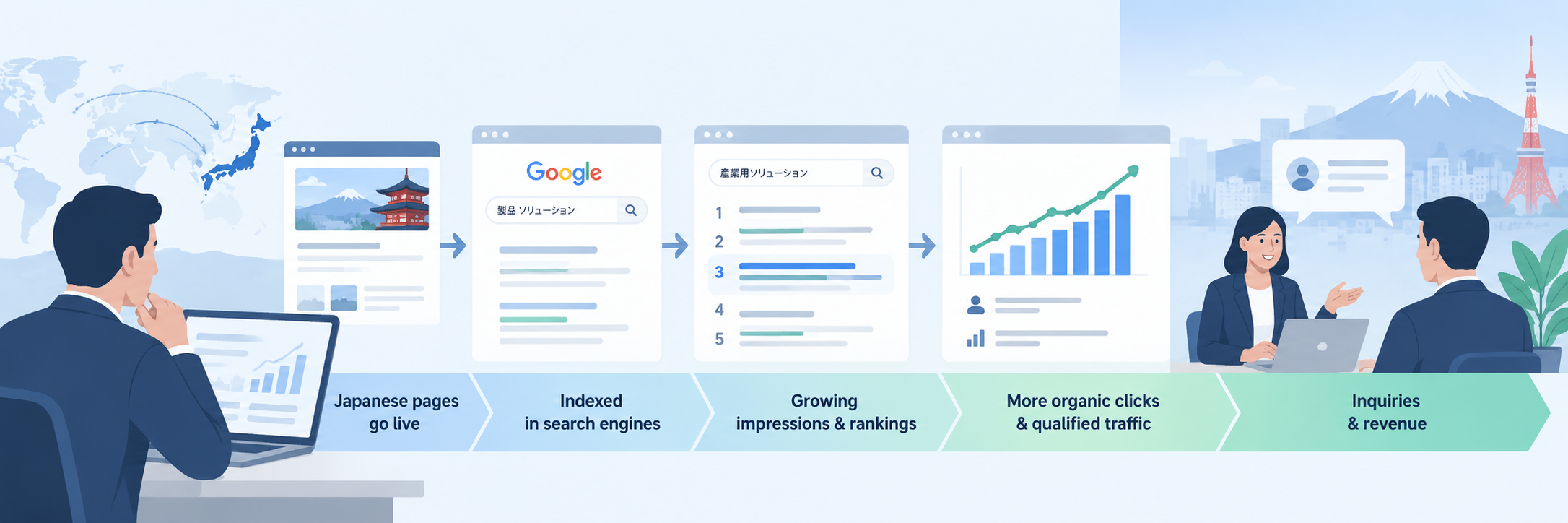
SEO results arrive in stages:
Index → Impressions → Rank movement → Top 20 → Top 10 → Clicks → Qualified organic traffic → Money Page transition → Inquiry → Pipeline → Revenue
These are not interchangeable outcomes. Indexation means Google included a version of a URL. An impression means the page appeared in a search result. A Top 10 position indicates first-page visibility for a measured query and context, but it does not prove that the query is commercially valuable or that the visitor is a qualified buyer. A click is not qualified traffic. An inquiry may not become pipeline, and revenue may be recorded long after the first organic visit.
This distinction is crucial in the first 90 days. An increase in Japanese impressions can be healthy evidence that Google is beginning to associate a page with relevant demand, while still being far from a sales result. Conversely, rankings for the wrong queries can look positive in a report and produce no business value.
A realistic Japan SEO timeline
0–30 days: make the foundation eligible
The first phase is about removing constraints that can make later content ineffective:
- Japanese keyword and search-intent research based on the actual Japan SERP;
- the correct URL for each priority topic and a plan to prevent cannibalization;
- indexability, canonicals, robots, rendering, speed, sitemaps, and server checks;
- Japanese folder/subdomain architecture and reciprocal
hreflangreferences where appropriate; - internal links to priority pages;
- Search Console, analytics, and conversion baselines;
- an implementation backlog with owners, dependencies, and approval dates.
Normal: a clearer baseline, technical blockers being removed, the first eligible pages being discovered or indexed, and initial impressions where demand and eligibility exist. It is not a failure if a competitive head term has not moved yet.
Investigate immediately: important pages remain blocked, the wrong canonical is selected, target pages are not in the index after a reasonable crawl window, or the team cannot identify which URL is intended to rank.
30–90 days: read the first search signals
After the first fixes and native Japanese pages are live, look for the shape of demand rather than a single headline position:
- relevant query coverage and impression growth;
- long-tail and lower-competition movement;
- some priority pages entering the Top 30 or Top 20;
- evidence that the intended Japanese URL—not an English page, translated duplicate, or unrelated page—is receiving visibility;
- early clicks and landing-page visits from the target market.
It is normal for impressions to move before clicks and for long-tail queries to improve while competitive head terms remain flat. If there is still no indexation or relevant impression evidence for technically eligible pages, investigate the page-to-intent match, content quality, URL ownership, and technical conditions rather than simply publishing more pages.
3–6 months: validate the model
This is often the first useful period for judging whether the Japanese keyword, content, site-architecture, and internal-link model is working as a system. You may see some reachable queries enter the Top 20 or Top 10, clicks from the target market, qualified landing-page visits, and movement into the Japan SEO money page or case studies. Early inquiries are possible when the offer, trust signals, and sales cycle support them, but they should not be promised.
If impressions grow without clicks, inspect the query mix, title, snippet, position distribution, SERP features, device, and actual Japanese wording. If clicks grow without qualified traffic, inspect geography, audience fit, and landing-page ownership. If qualified visitors do not reach commercial pages, inspect internal links, calls to action, and content architecture.
6–12 months: build compounding evidence
Six months is often the first useful point for judging whether a Japan SEO system is compounding—not a deadline by which every keyword should rank. The focus shifts to:
- broader coverage across the Japanese topic cluster;
- more stable Top 10 visibility for reachable topics;
- qualified organic traffic and repeat visits;
- depth into the commercial path;
- inquiry quality, sales acceptance, pipeline stage, and revenue evidence where the sales cycle is long enough to observe it.
New domains, competitive commercial terms, large architecture changes, and slow content or development operations can require more than 12 months. Review the project against its leading indicators and commercial assumptions; do not defend it by elapsed time alone, and do not stop it solely because one head term is flat.
Your starting point changes the answer
| Starting point | What changes the timeline |
|---|---|
| English-only site entering Japan | Usually the longest learning curve: the project must establish Japanese keyword-market fit, localized content, usable URL architecture, internal links, and a baseline of Japanese search evidence. |
| Existing Japanese site | Relevant, indexable URLs and existing query data can shorten the learning curve. Legacy cannibalization, weak content, or technical debt can remove that advantage. |
| Translation-only pages | Production may be faster, but literal wording can miss Japanese terminology, formality, category conventions, and buying intent. Treat translation as a hypothesis to validate. |
| Strong existing domain | Existing links and a known URL graph can provide a stronger discovery baseline, but they do not guarantee Japanese relevance, page ownership, or a ranking date. |
| Architecture or migration required | New folders, redirects, canonicals, internal links, and hreflang must settle together. Allow a stabilization period and expect temporary fluctuations. |
For multilingual sites, use separate URLs for each language or regional version and implement reciprocal, fully qualified hreflang references where appropriate. Google emphasizes that hreflang helps it understand localized alternatives; it does not detect language by itself, replace visible localized content, or fix an incorrect page-to-intent match. See Google’s multilingual-site guidance and localized-version guidance.
What speeds Japan SEO up or slows it down?
Progress is often faster when priority pages are already near the Top 20, the Japanese SERP is underserved, technical foundations are sound, Japanese content has enough volume and quality to cover the target topic, and a small set of pages can be researched, written, reviewed, developed, and published quickly. A focused group of 5–10 priority pages can produce more useful learning than a large volume of pages with unclear ownership.
Progress is commonly slower when:
- the domain or Japanese section is new and has little relevant content or internal-link context;
- English pages are translated sentence by sentence without native Japanese SERP research;
- the keyword does not match the category, use case, or buying stage Japanese users actually search;
- the target is a competitive commercial, finance, travel, e-commerce, or other high-trust SERP;
- a site move, folder change, redirect plan, canonical cleanup, rendering fix, or
hreflangimplementation is unfinished; noindex, robots, JavaScript, duplicate, soft-404, server, or internal-link problems prevent discovery or indexing;- content and development work waits through legal, brand, security, or HQ approvals;
- HQ and Japan stakeholders disagree about the customer, offer, terminology, or final decision owner;
- target URLs change every few weeks, measurement is incomplete, or the content program is paused before a pattern can form.
Operational speed is part of SEO. A technically correct recommendation that waits six weeks for approval has not yet had six weeks to produce a search result. Agree on the Japan-side reviewer, HQ decision-maker, developer, legal/brand dependencies, and the date each change becomes live.
How should you measure the project?
Use Search Console for impressions, clicks, queries, pages, country, CTR, and position. Use analytics for qualified behavior and commercial-page transitions. Use the CRM for inquiry acceptance, pipeline, and revenue. Google recommends using Search Console for how people arrive through Search and Analytics for what they do on the site; the systems will not match exactly. See Search Console’s Performance report and Google’s Search Console and Analytics guidance.
At minimum, report:
- indexed priority URLs and unresolved indexation issues;
- impressions and clicks by Japanese query theme and landing page;
- Top 30, Top 20, and Top 10 coverage for a defined, stable keyword set;
- qualified organic sessions or users by target geography, industry, and landing page;
- commercial-page depth: movement from discovery pages to Japan SEO services, case studies, and contact;
- inquiries, accepted leads, pipeline stage, and revenue with attribution rules documented;
- implementation velocity: approved, live, blocked, and average days from approval to publication;
- dependency delays involving HQ, Japan reviewers, developers, legal, brand, analytics, or sales.
Use this diagnostic sequence:
| Observation | Check first |
|---|---|
| No index | Canonical, robots, noindex, rendering, sitemap, links, server, and URL Inspection. |
| Indexed but no impressions | Japanese intent, page type, content depth, demand, competition, and competing URLs. |
| Impressions but no clicks | Position distribution, title/snippet, SERP features, device, and Japanese wording. |
| Clicks but little qualified traffic | Country, query intent, landing page, offer, and language experience. |
| Qualified traffic but no money-page transition | Internal links, CTA, commercial relevance, and page discoverability. |
| Money-page visits but no inquiry | Proof, localization, offer, CTA, form friction, response time, and sales fit. |
| Inquiries but no pipeline | Lead qualification, follow-up, handoff, and attribution. |
What about Yahoo! JAPAN?
Measure Google as the primary organic baseline and sample Yahoo! JAPAN separately where it matters to the target audience. Yahoo! JAPAN’s search technology and result presentation should not be assumed to be permanently identical to Google. A 2010 Japan Fair Trade Commission record documented a Yahoo! JAPAN plan to use Google search technology, but that historical record is not a guarantee of the current 2026 product or result presentation. The practical recommendation is to compare the two result pages periodically and document any material differences in visibility, features, and query coverage.
The short answer
Japan SEO can show early indexation, impressions, and query movement within weeks. Three months can be enough to see whether the technical foundation and Japanese intent model are producing signals. Six months is often a useful point to validate patterns. A new or competitive program should usually be planned over 6–12 months for qualified traffic and commercial learning, with longer horizons possible for scale. None of those windows guarantees a ranking, inquiry, pipeline, or revenue outcome.
For provider-selection criteria, read how to choose the right Japan SEO partner.
For scope and operating-model questions, see Japan SEO contract and retainer deliverables.
For detailed measurement design, see Japan SEO ROI and KPIs.
FAQ
Can Japan SEO produce results in three months?
Yes, if “results” means technical recovery, indexation, impressions, long-tail movement, or early clicks. Three months is usually too early to promise a stable Top 10 position for a competitive commercial term or to forecast revenue. Judge the project by the stage-appropriate evidence.
What should we expect after six months of Japan SEO?
You should have enough data to validate the Japanese keyword/page model, see which priority topics are gaining visibility, and evaluate qualified traffic and commercial-page depth. Some reachable queries may be in the Top 10, but competitive head terms or a new market entry may still need more time.
Does translating our English pages shorten the timeline?
It can shorten production time, but not necessarily the SEO learning curve. Translation is not the same as Japanese keyword research, native editing, local SERP analysis, or adapting the page to Japanese buying intent. Translation-only pages should be treated as hypotheses to validate.
Does a strong existing domain guarantee faster Japan SEO?
No. An established domain and relevant internal or external links can provide a stronger baseline for discovery and trust, but Google still needs a technically eligible page that satisfies Japanese intent. Existing strength helps; it does not guarantee a ranking or a date.
Should we measure Yahoo! JAPAN separately?
Yes, as a validation sample where Yahoo! JAPAN matters to the target audience. A 2010 Japan Fair Trade Commission record documented Yahoo! JAPAN’s plan to use Google search technology, but that historical record is not a guarantee of the current 2026 product or result presentation. Measure Google as the primary organic baseline and sample Yahoo! JAPAN separately rather than assuming that one report represents both.
When should we change the strategy?
Do not change it because a head term is flat after a few weeks. Change or escalate when important pages cannot be indexed, the site repeatedly attracts the wrong intent, no relevant impressions appear after technical eligibility and a reasonable observation period, or qualified visitors do not move toward the commercial path despite sufficient visibility. The fix may be technical, content-related, architectural, or commercial—not always “publish more.”
Is a six- or twelve-month engagement a guarantee?
No. It is a planning horizon for producing and learning from enough implemented work. No reputable provider can guarantee a first-place ranking. The scope, dependencies, leading indicators, and decision rules should be explicit from the start. For provider-evaluation criteria, see how to choose the right Japan SEO partner.
Need a Japan SEO plan built around your actual starting point?
The right timeline depends on your market, current Japanese pages, site architecture, content resources, implementation speed, and sales process. Trees Consulting can help you identify what should be fixed first and what evidence should be visible at each stage.
See Japan SEO services for global companies
For evidence from previous projects, review the Japan SEO case studies.